Monday, January 21, 2013

“Choice Architecture” and Teaching


Do you think that the choices your students make shape what they get out of your class?  Most teachers, if not all, would respond to that question with a rousing “Of course!”  Now, don’t you wish there was an easy way to get them to make better choices?  I’m Celia, a PhD candidate in Political Science and a Fellow with the Yale Teaching Center, and today I’m going to describe why thinking of yourself as a “choice architect” might help.

“Choice architecture” is not simply about physical buildings and structures (although they do play a role).  Rather, choice architecture is about the norms, habits, practices, and patterns that structure our social, political, and institutional lives.

Of course, these aren’t just my ideas – I’m working with a framework developed by Cass Sunstein and Richard Thaler in their recent book Nudge:Improving Decisions About Health, Wealth, and Happiness.  While Sunstein is a legal scholar and Thaler is a behavioral economist, political scientists frequently draw on Sunstein and Thaler’s work as well.  What do all these disciplines have in common?  They all share a concern with how people make choices and the factors that determine whether those choices are optimal or less than optimal. 

Sunstein and Thaler make a few key claims about choices:
  • Small changes in context make a big difference in the choices people make.
  • Individuals’ “true” preferences are hard to define and often not set in stone.
  •  When you are organizing a context in which people make decisions, “there is no such thing as a ‘neutral’ design.” (Sunstein and Thaler, p. 3)

Now, just think about all the choices your students make when it comes to your class.  Every week, they decide whether or not to do the reading.  They decide whether or not to speak in class.  They decide whether or not to take notes, and they decide whether to be there in class in the first place.  Moreover, they decide what kind of attitude to take – skeptical, engaged, bored, distracted, excited, or domineering.

You don’t have full control over ANY of these decisions.  Sure, you can lay down class rules and determine grades, and these are important instruments for shaping some of your students’ behaviors – but rules and grades are just too blunt to shape every single decision your students will be faced with.  

That’s where choice architecture comes in.  You want to organize your classroom to nudge students towards the best choices.  What are some ways to do that?  Here are a few:

1) Leverage the power of habit.  For example, you want to get your students talking during discussions?  Have them fill out weekly online response forms.  Just the act of writing something, anything about what they’ve read will help get them in the habit of A) doing the reading and B) having something to say about it.  Even if the response forms only account for some small percentage of their participation grade, they can have an outsize effect on student readiness to engage in class discussion.

2) Use social pressure to your advantage.  Split students up randomly into pairs to discuss a question, and walk around the room listening in.  The goal is not to create a high pressure situation, but rather to create a situation where the default is to participate.  Your students will feel more awkward if they sit silently with their partner than if they talk about the readings, especially if they see you walking around and listening in.

3)  Change the physical space.  Consider how you can modify the physical space of the classroom to address any challenges you might be facing.  If you’ve got only a few students in a big classroom, conversation often lags – you could try to get assigned a new room or get to the classroom early and use the chairs to create a smaller area in which to hold class.

Some of my favorite activities are those that combine several of these elements at once.  For example, last semester, when we were reviewing major Supreme Court cases relating to the Interstate Commerce Clause, I came up with a jigsaw activity for my students.[1]   I split students up into four groups and assigned one Supreme Court case to each group.  Each group had just ten minutes to prepare a brief presentation on the case and write an outline of their presentation on the board.  After the first set of presentations, each case would be passed to another group, and that group would have just a few minutes to prepare a presentation on the interpretation of the Commerce Clause in that particular case.  Then there would be a second round of presentations, after which each case would be passed to a third group, who would apply legal principles from that case to a new case currently before the Court.  Before each case was passed, the group about to receive the case would have the chance to ask questions of the group currently in possession of the case.

This activity ended up being a lot of fun – the students were engaged and enthusiastic – so that’s part of why I remember it fondly.  But it’s also a nice illustration of choice architecture in action.  Since students were in small groups, there was some social pressure to participate.  Because the activity involved writing on the board and time pressure, it got students moving and raised the energy level in the room.  Finally, because students had to ask each other questions before the cases were handed from group to group, they started to develop the habit of talking to each other about the material, and not just directing all their comments towards me.

I'd love to hear reactions to these ideas in the comments below.  What are other ways you could apply the principles of choice architecture to your classroom?  How might the features of choice architecture vary across classrooms in different disciplines?  What other insights about teaching can we draw from Nudge, or from other work in behavioral economics and behavioral psychology? 

References:

[1] The jigsaw classroom is a form of cooperative classroom learning, so-called because “just as in a jigsaw puzzle, each piece--each student's part--is essential for the completion and full understanding of the final product.”  For more information, see http://www.jigsaw.org/overview.htm

Tuesday, December 11, 2012

Museum as Classroom

Hello Teaching World! I am Alex, a 6th-year PhD candidate in the History of Art Department and a YTC Fellow. Today I'd like to tell you a little about teaching with art and, for those of you teaching in or around Yale, the wonderful Yale University Art Gallery, which reopens on Wednesday, December 12th.

Contrary to popular belief, museums are not scary places. Nor are they the private domain of experts, aficionados, and elites. No way! They are for the people, especially the free-of-charge YUAG, which has been from its inception a teaching institution. Better still, the museum has just undergone a substantial renovation and re-installation, nearly tripling its previous size. 


Even if you aren't teaching art history, a museum has much to offer many disciplines from Medicine to Japanese, especially the temporally- and geographically-extensive YUAG. The education department would be happy to help you select material and arrange a visit (contact David.Odo@yale.edu for more info). The objects you select could be similar to your discipline's subject (e.g. medical students looking at medical images) or similar to its methodology (e.g. anthropology students analyzing museum visitors' interaction with art objects.)

In this post, I will focus on the pedagogical benefits of close-looking at art objects.  The cornerstone of art historical methodology is visual analysis -- a close-looking of an object to build an interpretation. Formal analysis is analogous to "close-reading" in literature, but through parsing visual details rather than textual. The benefit of having a real, live art object is that you can look really, REALLY, REALLY closely -- sometimes even with a magnifying glass! This ability allows you (and your students) to more thoroughly understand the artist's choices, the life of the artwork, the chemical basis of the materials, and much more.


The first and foremost pedagogical benefit of a museum visit is how it can add variety to your teaching style. For most, getting out of the classroom is an invigorating experience that can inject any class with new breath. Additionally, a visit will activate  learning styles (VARK) sometimes lost in the classroom -- kinesthetic and visual -- through the sheer physicality of being in a museum and, of course, the visual material. Furthermore, you can use the museum  outside of classroom time, assigning short papers or presentations based on student research and/or observation.

Second, developing critical thinking through close-looking can aid in a student's overall intellectual development. It can make students more cognizant of their visual surroundings -- prompting them to question the images that bombard us daily, ranging from iPhone apps to CNN to fast-food ads. In the classroom, visual analysis provides an analogous method of critical thinking, which students may apply to other disciplines and contexts. The process of building an interpertation based on careful observation can also aid in the development of expository writing or even diagnosis.
 
Alongside this post I have a attached some Instagram photos I snapped at the YUAG last week. With these photos as an example, I would like to suggest a museum activity that you can use with your students, in a class or as an assignment:
1) Tell the students to bring a smartphone to photograph object(s) of their choosing.  
2) Have them also select frames and filters for their images. (Most young folk are very familiar with these photo-editing apps like Instgram, Picfx, or even Facebook).  
3) Depending on your class's subject matter, add a theoretical framework through which they should make these choices. This could be gender, spirituality, historical events, chemistry, physics, post-structuralism -- you name it! 
4) Then have the students present their photos and why they chose the object, composition, frame, and lens with regard to the theoretical framework. 
5) Commence fruitful discussion!

Thanks for listening! I hope you all get a chance to see the new YUAG soon! 


Images:
1. Central Stairway, Yale University Art Gallery, Louis Kahn Building, 1953
2. Benedetto Bonfigli, Christ the Redeemer, ca. 1455–1460  
3. Fukami Sueharu, View of Distant Sea II, ca. 1985 
4. Portrait of a Man, c. 300 A.D., and Portrait of a Young Man, 140-160 A.D., Ancient Rome (in far background: Joseph Wright, Portrait of Mr. William Chase, Sr., ca. 1760-6)
5. Sol LeWitt, Wall Drawing #786A, 1995
 

Saturday, December 1, 2012

Storifying Lectures

Lectures can sometimes be bland, unimaginative, and dare I say, boring. You know what isn't boring? Stories. Why can't lectures be more like stories? I'm Alp, a PhD Candidate in Biomedical Engineering, and I'm writing this week about "storifying" lectures.

Everyone must have experienced that rare moment of humanity when an instructor shares a comical anecdote. (My favorite was a tree falling into my instructor's living room and his deadpan reaction of "well, that's bad.") Injecting short stories into your lectures is never a bad idea, but this post is not about that. This post is about taking elements of stories that make them memorable and applying them to lectures. So what makes a story... well, good?

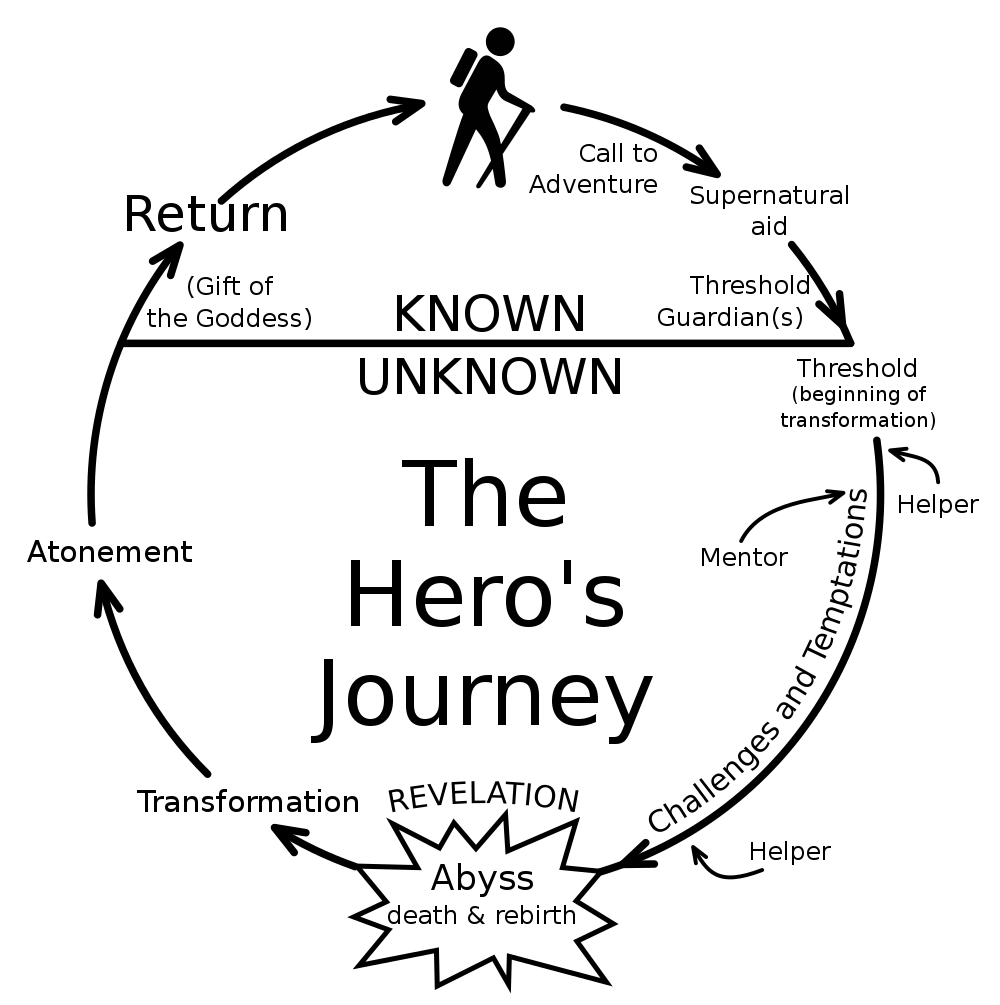
This is a big question. One proposal that seems convincing is Joseph Campbell's monomyth framework.1 Campbell posits that many narratives from around the world exhibit a basic outline of a hero's journey from a (known) stable world, to an (unknown) suspenseful realm, and back again. Think of the Lord of the Rings books or the original Star Wars movies as a modern example.


So can we, as lecture designers, use any of this? I say, sure! In our case, the student is the hero/ine who steps from the known world (understanding) to the unknown world (new concepts). The journey (lecture/course) brings her back to the known world through the guidance of a mentor (the instructor) and helpers (teaching assistants). So what are some concrete tips we can draw from this parallelism? Let me propose two:
  1. Call to Adventure: Think of a bad movie you saw recently. I'm willing to bet you that the reason you didn't like it is because you didn't relate to and/or understand the problem. Same thing with lectures. Students who can't immediately see why they are studying what they are studying will be less likely to pay attention. What to do? Try to precisely motivate the challenge to be tackled in the lecture at the very beginning. Convince your students that the story you're about to tell them matters. Not just to the world, but that it matters to them. This (image) is what you're going for, right off the bat.
  2. Suspense in the Unknown World: Suspense is a great narrative tool. It presents an irresistible incentive to pay attention. The audience feels invested in the problem. Well, guess what? The "unknown world" of lectures if full of problems! So use suspense to draw the students in. Separate the description of your examples from their solutions. Instead of first lecturing on a topic and then following up with examples, state the example first but don't solve it just yet. Get your students to think about it. (How about a short "think-pair-share" exercise or a clicker question?) This creates tension as students realize that they need more knowledge to solve the problem. Now lecture for a bit to develop the necessary knowledge base, and finally solve the example to conclude the suspense. Same material, same time, but so much more exciting!
None of this is pedagogical science; I make no claims about the effectiveness of such approaches. But, the art of storytelling is a product of thousands of years of human curiosity, ingenuity, and dedication. Everyone knows a good story when they hear one... and some even remember them well enough to pass them on. Isn't that one of the goals of lecturing? Seems silly not to tap into such a rich resource for inspiration. See what storytelling tips you can come up with! (Share them in the comments below!)

References
1Campbell, Joseph. "The Hero with a Thousand Faces." (1949).

Monday, November 26, 2012

Classroom Assessment Techniques


This week’s post is written by Claudia, a Ph.D. candidate in American Studies and Film Studies, and it’s about classroom assessment techniques.

Many of us have learned the hard way that it’s better to test students’ grasp of the material before it’s time to grade their assignments. One category for such tests are called “classroom assessment techniques.” This is the broad term for activities that teachers can do during class time to assess both the quality of the students’ retention and the effectiveness of the teacher’s strategies.

Three CATs to Try

1. Background Knowledge Probe
 Before teaching new material, ask students to make a list of what they already know about the subject area. Collect the lists, and report the results back to the students. At the end of the unit, you can repeat this activity, to show the students how much they’ve learned.

2. Misconception/Preconception Check.
This one is particularly useful if you’re teaching a subject to which students come with prior knowledge that may be incorrect. Consider what common misconceptions students bring to your subject area, and distribute a survey that asks students about these misconceptions. The teacher of a political science class on the Middle East may want to distribute a short survey that tests students’ basic assumptions on the region:

1. Arabic is the language most commonly spoken in the Middle East.

(Isn’t true)
(Might not be true)
 (Think is true)
(Certain is true)
2. Islam is the dominant religion in the Middle East.

(Isn’t true)

(Might not be true)
(Think is true)
(Certain is true)
3. Most of the oil consumed around the world comes from the Middle East.

(Isn’t true)

(Might not be true)
(Think is true)
(Certain is true)
4. List the countries generally considered part of the Middle East:


You can conclude this exercise by either correcting the students’ answers or having them research and correct their own answers as a homework assignment. It also may be useful to have a group discussion about where students’ preconceptions have come from.

3. Memory Matrix.
Have students fill in an empty chart, either individually or in groups, to assess their recall of recent material. This helps the instructor know whether students are making the right associations between people, terms and/or ideas. A teacher in a film class may want to give students the following matrix, to work on individually or in groups:
  

Country of Origin
Major Film(s)
Associated Style
Fritz Lang


John Ford


Vittorio De Sica


Satyajit Ray


The activities above are taken from  Thomas A. Angelo and K. Patricia Cross, Classroom Assessment Techniques: A Handbook for College Teachers (San Francisco: Jossey-Bass Publishers, 1993). More CATs and more detailed instructions can be found in this book.

Saturday, November 10, 2012

Using Online Videos for Teaching In and Out of Class

I spent a very fun week this past summer at the American Association of Physics Teachers  meeting. As a 6th year graduate student in physics who is very interested in teaching, I found it invigorating to be surrounding by other physics-loving teachers. One of my favorite sessions from the meeting was a "YouTube Sharathon" where physics teachers would share their favorite YouTube videos for use in the class along with associated student activities. I came away with lots of exciting ideas for using videos in and out of class that I thought I would share with you here.

I mostly have physics and math examples, but videos are useful for ALL disciplines so I would love to hear your own thoughts on the use of online videos in your discipline and/or your own favorite educational online videos in the comments below!

(1) Connecting concepts to the real world in class
Teachers often say they want to connect course content to the 'real world' to (a) help with students' understanding or (b) make the content more interesting for their students. Using short online videos in the classroom can certainly help with these goals. The entertainment factor is a given (who wouldn't love spending class time watching something!), but making sure the video is effective in engaging students with the content and/or concepts you want them to learn is more tricky.

Teachers should have clear goals and objectives in mind for what they want students to take away from the video and clearly convey these objectives to their students. To help students achieve these objectives, the teacher should plan an activity around the video. These activities can vary greatly, from having students analyze the James Bond airplane stunt in Goldeneye to determine its scientific plausibility, to leading a discussion on the broader relevance of information transfer after watching the 'levitating slinky' video (see below). This experience will certainly be fun for the students, and also provide a great opportunity to connect abstract or difficult concepts to the real (or virtual) world around them.


(2) Learning content outside of class
A popular new style of teaching found to significantly enhance student learning is the flipped classroom - essentially where content coverage is moved outside of class and class time is spent addressing misconceptions and engaging with the material in more depth. Assigned reading is of course one way of pushing content coverage outside the classroom, but students rarely do this reading without extra incentives. Online videos can be a great way to cover out-of-class content, with the incentive that it will actually be entertaining and educational. And, don't worry, there are a lot of online videos that cover content in a more vibrant manner than traditional lecture.

Here are some of my favorite sites to find videos for learning content, and feel free to share your own!

(a) Vi Hart's YouTube channel for math concepts, but to get you started, here's a video exploring binary trees through doodles:


(b) Minute Physics YouTube channel, which addresses a lot of interesting physics questions.

(c) Check out Ted Ed for great educational videos on a wide variety of topics.

Those are my thoughts on online videos in and out of the classroom, but feel free to share your own in the comments section below!


Monday, November 5, 2012

The Teaching Statement out and about on the Job Market

This is Miti – one of the GTC fellows this semester. I am a 7th year in the History Department. As the year of my studies at Yale may indicate to you, I am on the job market. This is my second time around on that particular carousel. Teaching figures heavily in my applications this year, as well as last year. All the positions on my color-coded job-spreadsheet involve teaching. As last year, the vast majority ask for a teaching statement. It seems like more applications call for a teaching statement than a sample of my research.
What, then, is a teaching statement, this vital document? Let us do what most students do: turn to the Web! 

Princeton’s Center for Teaching & Learning explains: A teaching statement is a 1-2 page single-spaced essay that explains your teaching strategies and goals and in the terms of your discipline and in the context of the teaching positions you have held and seek to hold

Vanderbilt’s Center for Teaching makes is a bit more personal: is a purposeful and reflective essay about the author’s teaching beliefs and practices. It is an individual narrative that includes not only one’s beliefs about the teaching and learning process, but also concrete examples of the ways in which he or she enacts these beliefs in the classroom. At its best, a Teaching Statement gives a clear and unique portrait of the author as a teacher, avoiding generic or empty philosophical statements about teaching.

Great! However, what is it in practice for me, as I prepare for the job market – or the Certificate in College Teaching Preparation here at Yale? Looking back over my double-digit number of drafts (counting only the ones that I thought were final at some point), the one hard and fast thing I can say is, that the teaching statement is the single most difficult text I have ever written. After all, this is the document that will give a hiring committee an idea of me as a teacher – something the positions I have applied for, am applying for, and will apply for put a lot of emphasis on. That is a lot to put into two legible pages: explain my teaching strategies and goals, an individual narrative that avoids generic and empty platitudes, how I am in the classroom.

Yet, the teaching statement is exactly the document that gives the hiring committee the best glimpse of me as a person – as a potential colleague. It is two pages of me in a pile of hundreds of pages of hopeful and competitive applications.


Imagine it, December 2012… 

A professor is sitting in a lit office – it is dark outside. Maybe it is snowing. Final papers will be due and students are e-mailing panic-struck messages and contesting midterm grades. The editors for the professor’s newest book are asking for changes (about image reproductions rights no less!) and a committee the professor is on had a meeting that ran late. Again. The coffee ran out. Again. In addition, she or he has a pile as high as the Eiffel Tower is tall of job applications. The massive pile has been culled once based on completeness of application (not all three letters of application have come in? Discarded.); formal requirements (only one chapter of the dissertation is completed? Discarded.); cover letter (applicant’s research and teaching interests do not jive with the department’s needs? Discarded.) 

The professor reaches for the application on top, and flips to the teaching statement. She or he begins to read.


Is that my teaching statement the poor coffee-deprived faculty member is reading? Is my first sentence captivating enough to keep the professor reading to the end? Will he or she be able to imagine me in a classroom? Will I be likeable in those two pages? In addition, above all, will my teaching statement help me get the job? That is how important this document can be. It may not be, but that is how I have written mine, and considering the emphasis on teaching in so many of the History jobs announced I do not think it is unfounded. In addition, in my one, single job interview last cycle, this was the focal point of the interview. 

We are trained in academic writing. For the last six years, I have worked hard to eliminate my personality, my voice, from my writing. Yet now I am asked to expose my teaching personality, me in the classroom, to a random stranger who really just wants the Eiffel Tower pile of applications to magically disappear. 

How do I write that statement, being read in a far-away office? This is an essay: introduction, body, and conclusion. This is thesis-driven paper: the thesis is that I am a great, dedicated teacher. The teaching statement is there to provide evidence. The best way to expose Miti the teacher (I distill from workshops, reading obsessively online, and from feedback from colleagues and GTC staff) is to use concrete examples: Teaching goal – challenge in the classroom – action teacher/you took – student response. The statement is more than an expose of a teacher; it is also a writing sample. Clarity, structure, and style are important to the document. 

There is no one, tested and true, way to write a teaching statement. However, there are many great resources out there. The Internet is filled with useful resources – you can easily waste a week surfing around looking at different universities’ tips and sample collections

 Apart from the links above, I have found The Professor Is In an invaluable resource, especially her acidic post on the eightpitfalls of the teaching statement.
  
Chronicle of Higher Education of course has articles on the Teaching Statement:
Writing a teaching statement is very difficult. Do not expect it to be easy. But there is help out there! Do not hesitate to ask professors, friends, colleagues, and random strangers to read your Statement. The GTC is an excellent resource. My statement has seen three dramatically different “master versions”, two of which were made infinitely stronger than the previous ones, thanks to conversations with GTC staff. Am I tooting our own horn, why yes I am! Thank you for noticing.

For all of us writing our teaching statements – keep your eye on the prize: the job that will let you continue to develop as an academic researcher and teacher.

Here’s to hoping that when the caffeine deprived, tired, and over-worked search committee comes to your teaching statement, he will look up, stare off into the distance, and think “Wow! I could learn so much from this applicant as a colleague and a teacher…” and then he or she moves your application into the “Interview” pile.


Monday, October 29, 2012

A Periodic Table of Visualization Methods


This week’s post is about “A Periodic Table of Visualization Methods” (henceforth APTOVM), a resource that details and categorizes the many ways of presenting information visually.  I’m Damian, a Ph.D. candidate in Music Theory.

Here at the Graduate Teaching Center we believe that one of the foundational skills of successful teaching is understanding how people learn and teaching accordingly.  There are several inventories that conceptualize the ways in which people learn (see Coffield, F., D. Moseley, et al. (2004) for an overview of learning-style inventories); one particular inventory that APTOVM directly speaks to is VARK.  The VARK inventory posits that information can be presented in Visual, Auditory, Read/Write, or Kinesthetic modalities, and that different people have different ways (or combinations of ways) in which they prefer to take in (or give out) information.  As teachers, then, we can strive to find modes of presentation that that best suit both the material and our students’ learning preferences

The Visual preference “includes the depiction of information in maps, spider diagrams, charts, graphs, flow charts, labeled diagrams, and all the symbolic arrows, circles, hierarchies and other devices, which instructors use to represent what could have been presented in words.  It could have been called Graphic as that better explains what it covers” (from www.vark-learn.com; visit to learn more about VARK!).  APTOVM can help us both devise ways to present information visually and concoct activities/assignments that give students the opportunity to interface with information visually.  The table groups methods into data-, information-, concept-, strategy-, metaphor-, and compound-visualization categories; it also labels whether each method depicts structure or processes, details or an overview, and divergent or convergent thinking.

While we might initially associate the visual presentation of information with quantitative fields (graphs, charts, and the like), APTOVM demonstrates how visualization methods can be applied in any class.  Some ways that I’ve used visualization methods in my own teaching have been:
  • having students produce their own decision-tree algorithm of how to harmonize a simple melody
  • diagramming sonata forms’ thematic-material and harmonic relationships with boxes at the blackboard
I hope you have fun exploring the table, and would love to read in the comments about the ways you use visualization methods in your own teaching!